
Sri Venkateswara swamy Temple
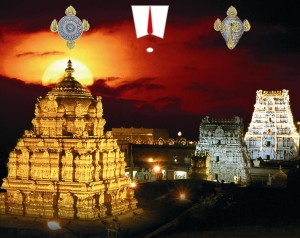 Sri Venkateswara Temple which is the most ancient Prligrim Center in India is on Tirumala Hill. This Temple is in the geographical limits of Tirupathi in Chittoor District. The Tirumala Hill forms the southern end of the Eastern Ghats in Andhra Pradesh. It rises to a maximum height of 1104 metres above the sea level and consists of seven peaks or ridges, hence the name Sapthagiri or Seven Hills. It covers an area of about 250 Sq Km and resembles a massive Serpent, giving it the name Seshadri or the Hill of Snake. The head of the Serpent is Tirumala, the body is Ahobilam to the North & the tail is Srisailam, even further North. Lord Venkateswara Temple is on Venkatadri which is one of the Seven hills. Tiru means ‘Holy’ or ‘Sacred’ and mala means hills/mountain in Dravidian languages. Therefore it translates as Holy mountains.
- Seshadri – Hill of Sesha,the dasa of Lord Vishnu
- Vrushabhadri — Hill of Nandi, the vahanaof Lord Shiva
- Anjanadri — Hill of Lord Hanuman
- Neeladri — Hill of Neela Devi
- Garudadri — Hill of Garuda, the Vehicle of Lord Vishnu
- Naraynadri — Hill of Narada Muni
- Venkatadri — Hill of Lord Venkateswara
He is also called Srinivasa, Tirumalesa, Tirumalappa, Timmappa. This temple has acquired a special sanctity in the Hindu religion. The benefits that accrue by a pilgrimage to this holy town is mentioned in the Vedas and Puranas. Hindus all over the world believe that in Kali Yuga it’s possible to attain mukti by worshiping Lord Venkateswara. There are footsteps leading to the hill with two separate serpentine roads to reach the shrine. According to legend, God Vishnu revealed himself earlier in the previous incarnations as Varahaswamy on the banks of the present temple tank.. This manifestation of the white boar (Sveta Varaham) is enshrined in the Adi Varahaswany temple situated on the northeastern banks of the tank. “Ven” means “sin” and “Kata” means”destroyed” Therefore Venkata means, a person who worships there will get cleansed of all sins. Around 50,000 pilgrims visit the temple every day.
Tirumala is known to have a history that goes back to the age of the Sangam Literature that lasted from 500 B.C. to 300 A.D. The reference of the famous shrine in Tirupati can be found in the literature of IIango Vadigal’s Silapadikarm and Satanar’s Manimeghalai Bear. The Tirumala hills are known to be world’s second oldest rock mountain. Thondaiman, ruler of ancient Tondai Nadu is believed to have first built the temple after visualizing Lord Vishnu in a dream. He built the Gopuram and the Prakhara, and arranged for regular prayers to be conducted in the temple. Later on, the Chola Dynasty (300 BC–1279) vastly improved the temple and gave rich endowments.
Some of the earliest rulers of Tirumala are the Kings of Pallav kingdom which is known to be there around the 4th century AD. The temple is known to have been brought to limelight by the Alvars or Vaishnava saints, who were the followers of Vishnu and sung praises of the Lord, in the 5th century. Tirupati has been ruled by various kings belonging to different dynasties, like Cholas, Hoysalas and Vijaynagar rulers. All the kings have played an important role in the expansion of the temple structure. Tirumala was a subject to Muslim invasion around the 12th century and it was during this time that the deity of Srirangapatna was brought to Tirupati for safety.
In 1517 Vijayanagara ruler Sri Krishna Deva Raya, on one of his many visits to the temple, donated gold and jewels, enabling the Vimana (inner shrine) roofing to be golded. Statues of Sri Krishna Deva Raya and his spouse stand in the premises of the temple. After the decline of Vijayanagara Empire, kings from states such as Mysore and Gadwal worshiped as pilgrims and gave ornaments and valuables to the temple. Maratha general Raghoji I Bhonsle (died 1755) visited the temple and set up a permanent administration for the conduct of worship in the temple. There is an idol of Raja Todar Mal who was the revenue minister of Akbar, greeting pilgrims in the premises of the temple.
Sri venkateswara Temple will be in accordance with Vaishnava Sampradaya. Sri Venkateswara Swamy who is on the Tirumala hill got the fame of being the most sacred even before 18th Century. Let us make our lives meaningfull by visiting Venkateswara Swamy who made his presence in the central part of the Temple. We can see Mandapas statues and doors which were carved and designed in a beautiful way in the premises of the Temple, which should be visited and known in the premises of the Temple
Sri Varahaswami Temple
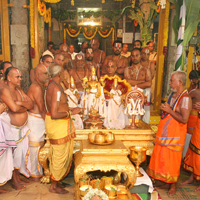
The famous temple of Sri Varahaswami in Tirumala is to the north of the Sri Venkateshwara temple, on the banks of Swami Pushkarini. The presiding deity is Varaha Swami, an incarnation of Lord Vishnu in the form of a boar that was staying on the hills when The Lord descended unto earth.
He had to take permission from Lord Varaha Swami to stay here and grant HIM (Lord Varaha), the privilege of first view by the visiting pilgrims and first Naivedyam (sacred offering of food to Lord for consecration) in return. Thus it is imperative that pilgrims visit Sri Varaha Swami first and The Lord, only later. According to legend, Tirumala was originally the Adi Varahakshetra (place belonging to Sri Adi Varahaswami). Lord Sri Venkateshwara took up residence here, with the permission of Sri Varahaswami. According to Brahmapurana, Naivedyam (food offered to God) should first be offered to Sri Varahaswami. Pilgrims should visit Sri Varahaswami temple prior to Sri Venkateshwara temple. According to Atri Samhita (Samurtarchanadhikara), Varaha Avatara is worshipped in three ways as Adi Varaha, Pralaya Varaha, and Yajna Varaha.
The idol of Sri Varahaswami in Tirumala is that of Adi Varaha, as it resembles the description of the Adi Varaha Murti in Vaikhanasa Agama texts.
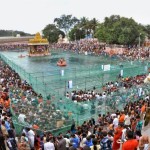
Swami Pushkarini
Tirumala Hill is a vast area with many peaks from which lakes & waterfalls rises. Of these, 108 are believed to be sacred and associated with various epic characters and miracles of Lord Venkateswara.
The Swami Pushkarini belonged to Vishnu in Vaikuntam, and was brought to the Earth by Garuda for Vishnu’s sport. On the western bank of the Swami Pushkarini is Sri Varahaswami’s temple, while on its southern bank is Sri Venkateswara swamy temple. It is the sacred tank, even regarded as equivalent to the Ganga and other sacred rivers. A dip in the tank, cleanses the bather of all sins. The performance of the daily rites or even occasional rites on the banks of the Swamy Pushkarini is said to cure deformities of the body and ensure the avoidance of all types of hell. It grants the wishes of those who bathe in it. Like the Hill, all the tanks and lakes of Tirumala are sacred and known as Theerthas. There are 17 theerthas whose Holy waters are believed to mingle in the Swami Pushkarini to wash off their sins.
The sacred Mukkoti or parva dina of the Swami Pushkarini takes place on Dvadashi in the month of Dhanurmasam (dec-Jan) when Vishnu’s chakra is taken in procession and immersed in the Swami Pushkarini, when all the Gods bathe in the tank. A bath at the same time, washes all the sins. It is believed that all the sacred waters including Ganga, merge in Swami Pushkarini once in a year.
The wooden-float festival of Lord Sri Venkateswara in the month of February/March and Avabhrudhasnanam or Chakrasnanam during Brahmotsavam takes place in the Swami Pushkarini.
Sri Bedi Anjaneyaswami Temple
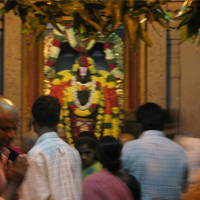
Tirumala hill is also known as Anjanadri, because Hanuman ( The Wind God) Took birth on earth here Sri Baydi Anjaneyaswami Temple is located on Sannidhi Street, opposite the main temple.
The idol of Sri Anjaneya is shown with its hands folded in supplication (the Anjali pose). Rarity of the temple is that we find Lord Hanuman in astanding pose with folded hands tied with a chain. Lord Hanuman as a child (Bala Hanuman) was highly mischievous and disturbing the sages on the hill while performing penance. In order to control Bala Hanuman his mother tied him with iron chain which is known as Bedi (hand-cuffs) in Telugu language.
Abhishekam is performed every Sunday and special offerings are made on Hanuman Jayanti.
Silathoranam
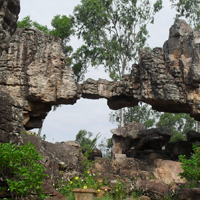
Silathoranam is a natural rock formation, which has got enormous value from archaeological point of view, Silathoranam near the Chakra Teertham is a must see spectacle. Since the rock look likes and appears to be the hood of a serpent, a conch and a discus, it is conceived that this source is dedicated to Lord Venkateshwara idol.
This arch formation is categorized as pre-Cambrian that dates back to millions of years ago. It is said that there are only two other sites like this in the entire world itself. The other two are the one that cuts through the headland of the Dalradian Quartzite in Uk & the Rainbow Arch Bridge of Utah in USA .
Geologists found out Silathoranam accidentally while excavating a geological fault on Tirumala Hills. This wonderful phenomena of nature has been subjected to various schools of thoughts. Some are of the view that it could be the effect of a wave action from oceanic transgression or intensified climatic settings and corrosion. Others opined that it might have been carved out of quartzite. A national monument protected by the state government, this natural splendor fascinated quite a number of tourists.
Srivari Padalu
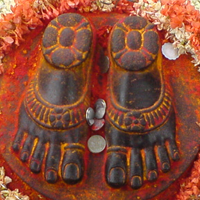
The place where Lord Venkateswara is believed to first set his foot on earth is known as “Srivari Padalu”. The foot prints of Lord Venkateswara are found at this place. This place is on a hill, known as Narayanagiri and which is the highest of the Tirumala Hills. We can have a complete view of the Tirumala temple from this place. There is garden very near to Srivari Padalu and the amazing Silathoranam is also situated here.
Papavinasam
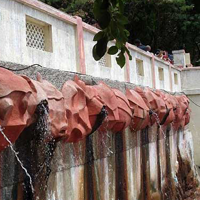
Papavinasam is situated just 7 Kms away from Tirumala, It is one of the prettiest and important waterfalls in the temple city. As the name denotes, Papavinasam is the place where all the devotees frequents with the belief that a holy dip would redeem them from their sins. Pilgrims can avail the dressing rooms as there is a separate room built for both men and women. Since the waterfall is gushes from the top of a hill, it looks picturesquely awesome. Access to this lovely falls through the stony footpath also makes your trip quite enjoyable. Another fabulous site is the reservoir of the nearby dam, which restricts the water flow in the pond. A well maintained park and a garden attributes the charm of the scenic surroundings pretty well.
Akasaganga Theertham
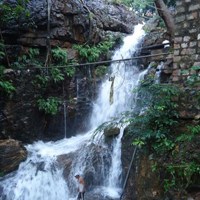
Akasaganga Theertham in Tirumala holds fabulous legends about its origin. One of the waterfalls found in the near surroundings of the main temple, this sacred torrent gains predominance over the others since all the rituals are conducted with the holy waters of this Theertha. It situates just 5 kms away from the main temple and traditionally the Tirumala Nambi family is allowed to take water from the waterfall to the temple.
hough there is an enormous legend about this lovely waterfall, which blooms to its zenith in the rainy season, the most prevalent among is the one that the lord himself had showed this waterfall to the person who used to bring water for his daily poojas. The gurgling waters of this stream make an awe inspiring scenery in rainy season. Apart from its pictorial vistas, the brook appears so tempting that one could not spare the desire to take a refreshing bath in the gushing stream. This holy Theertha is found it’s rendering in the Vedas and it is believed that Akasa Ganga Teertham originates from the feet of the deity.
Hathiram Bhavaji
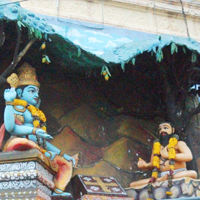
Hathiram Bhavaji was a Bengal devotee who came to the hill 600 years ago to worship Lord Venkateshwara. He built an ashram where he lived alone, and was known as Sevadasji. As his mode of worship was mystical and different, he was avoided by the others. So the Lord visited him every night and they would play a game of Dice together.
One night the Lord left his Pearl necklace in his house. When Sevadas took it to the temple, his story was not believed, and he was imprisoned for theft. Sevdas prayed to the Lord to prove his innocence. At midnight, a white elephant entered the prison cell. The terrified jailers ran & temple authorities opened the prison doors, they found that the Elephant was eating all the sugarcanes which they ordered him to eat, the elephant vanished before their eyes, leaving them dumbfounded, Sevdas ran to the temple shouting “Hathiram” (hathi =elephant). The Nawab trusted the devotion & appointed him as a Principal officer of the temple. His innocence was established and came to be known as Hathiram Mahant.
Padmavathi Temple
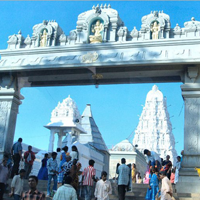
Sri Padmavati Devi Temple, Tiruchanoor, also known as Alamelumangapuram, is about 5 km from Tirupati. The presiding deity of the temple is Sri Padmavati Devi, the consort of Lord Sri Venkateshwara. It is said that a visit to Tirumala is fruitful only after visiting the Sri Padmavati Devi temple. The deity, Sri Padmavati Devi is seated in ‘Padmasana’, holding a lotus in both of her upper hands. Her lower hands are in poses of ‘Abhaya’, fearlessness, and ‘Varada’, benediction. The other deities in this temple are Sri Krishna, Balarama, ‘Sundararaja Swami’, and ‘Surya-Narayana Swami’. It is traditional to first worship Sri Krishna and then to take darshan of Sri Padmavati.
According to tradition, the Goddess Padmavathi Devi manifested herself in the Holy Pushkarini called Padmasarovaram in a Golden Lotus. The Venkatachala Mahatyam states that Lord Suryanarayana was instrumental in blossoming of the lotus in full splendour. A temple dedicated to Lord Suryanarayana is situated on the eastern side of the Pushkarini. The manifestation of Sri Padmavathi Devi occurred in the month of Karthika on Sukla Paksha Panchami when the star Uttarashada in the ascendent.
Sri Padmavati Devi, being wife of Lord Venkateshwara, her temple is away from Sri Venkateswara’s temple, as according to the legend, Sri Maha Vishnu, who later took on the incarnation of Sri Venkateswara, showed his reverence towards the sage, ‘Bhrigu Maharishi’, even though the sage had insulted Vishnu by kicking him on the chest. In anger, Sri Maha Lakshmi (the Lord’s consort) reached ‘Patala Loka’, where she heard a divine voice stating that a ‘Pushkarini’ was dug on the banks of the river ‘Swarnamukhi’, and here She immersed herself in penance for 12 years. In the 13th year in the month of karthika, on panchami day, Sri Padmavati Devi emerged from a Golden lotus.It is believed that Goddess Maha Lakshmi herself emerged as Sri Padmavati Devi.
Prasanna Venkateshwaraswami
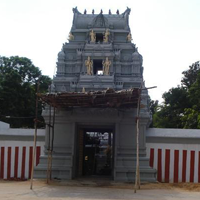
Sri Prasanna Venkateshwaraswami temple is located in Appalayagunta, 14 km from Tirupati. It is the place where Lord Venkateswera took his rest on his voyage to Tirumala.
This legendary place is believed to be the spot where the lord blessed Sri Siddeswara and other sages after marrying Sri Padmavathi Ammavaru. The main deity in the temple is famed for its joyous mood and it is assumed that the idol is a self-manifested vigraha. Apart from the main shrine of Venkateswara, the temple premises houses a shrine for Anjaneyaswami, Goddess Padmavathi and Sri Andal also. This fabulous shrine is constructed under the patronage of Rajas of Karvetinagar. It is believed that the devotees, for respite from unceasing ailments, adore the impressive deity of wind-god. Abhishekam on fridays witness large participation of pilgrims since it holds the belief that it would fulfill all their dreams. Brahmotsavam is celebrated once a year.
Narayanavanam
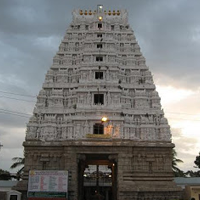
Narayana Vanam is a small town which is at a distance of 22 km from Tirupathi. In ancient times Narayanavaram was the Capital of the Karvetinagar kingdom which was ruled by Suryavamsa’s.
According to the legend of the land, Lord Venkateswara swamy married goddess Padmavati Devi at this place and stayed for the first few days after their marriage in this place, hence the name Narayna vanam which means Narayana – Lord Venkateswara, Vanam-place/park.
The presiding deity is Sri Kalayana Venkateswara with Lakshmi Devi on his chest, a hunting sword in his hand, Metal belt of Dasavatara, Kalyana bangle & Salagrama Japamala can be seen.
The other deities present inside this temple are Sri Pavasaverwara Swami Temple, Sri Veera Bhadra Swami Temple, Sri Sakthi Vinayaka Swami Temple, Sri Agastheeswara swami Temple & Sri Avanakshamma Temple, Sri Padmavathi mother temple, Sri Andal Temple, Sri Seetha Lakshamana sameta Rama Temple, Sri Ranga Nayakula Swami Temple. The Speciality of this temple is ,Lord will appear with open eyes. Due to this devotees will be greatly enjoyed with the visit of Lord`s eyes.
Brahmostavams will be conducted every year on Sankranthi and main festivals celebrated here are Andal neerostavam, VaralakshmiVratam, Teepostavam, Radhasaptami, Ugadi, SriRamanavami, Chitrapournami, Andal Tiravadi Puram, Deepalvadi, Vykunta Ekadasi and Dwadasi.
Here the largest Tirugali (grinder) can be seen. It is said that, on the marriage day, Nalugu is done with the flour that in taken from this Tirugali.
Sri Veda Narayana Perumal
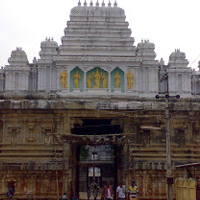
Nagalapuram is a small town in Andhrapradesh, about 70 kms south-east of Tirupathi. This ancient and vast temple was built during the reign of Krishnadevaraya. He had named this town as Nagamambapuram in memory of his mother Nagamamba.
The temple spread on a very vast area with grand Gopurams and huge prakaarams. Now the temple is wonderfully maintained by TTD with beautiful gardens along the prakaarams.
The presiding deity is Sri Veda Narayana Perumal in Mathsya Avatar along with his consorts Sri Devi and Bhu Devi. This temple is called Mathsya Avataara Sthalam, the avatar (incarnation) which is the first and foremost among 10 Avatars of Lord Vishnu.
According to the legend, a demon king called Somukasura once stole the 4 Vedas and kept them in his custody under the sea. Brahma, who is the creator, was worried as the whole world cannot function without the presence of Vedas. He went and pleaded to Lord Vishnu to save the Vedas and the universe.
Lord Vishnu, took the avatar in the form of a Fish (Mathsya in Sanskrit), went deep into the sea and fought with Somukasura. Somukasura was defeated in the battle by Lord Vishnu, who brought back 4 Vedas and handed over to Lord Brahma safely. As God saved Vedas here, he is known as Sri Veda Narayana Perumal. The other deities present here are Lord Ganesha, Dhakshinamurthy, Sri Venugopala Swamy, etc., among many others.
The Speciality of this temple is the Surya Pooja which happens annually during the temple’s Brahmotsavam on Sukla Dwadasi, Trayodasi and Chathurdasi days of Tamil month Panguni which is approximately around the last week of every March.
On these 3 days one can witness the Sun’s rays from the horizon, entering the sanctum and falling at the Lord’s Feet on the first day, Naabhi (Navel) on the second day and Forehead on the third day, during the sunset, as the Lord here is facing towards west. All this happens not from the ceiling or any opening in the temple, but from the entrance of the temple. The deity is about 600 meters from the main Gopuram entrance and the Sun’s rays have to pass through such a distance to fall directly on the deity.
This miracle never happens again throughout the year except these 3 days. This event signifies Sun God’s (Surya) Seva to the Lord to warm up his chilled body, as the Lord has been under water for many years during his war against Somukasura.
Also it is still not understood whether it is the architectural or astronomical brilliance by our ancestors, as this has been happening for ages from now. Large numbers of people throng this temple to witness this rare event.
Sri Pallikondeswara swamy
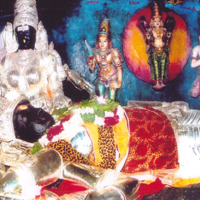
Palli Kondeswarar Temple is a Hindu temple dedicated to Lord Siva located in Surutapalli, a village in Chitoor district of Andhra Pradesh state close to the border of Tamil Nadu, India. Palli Kondeswarar translates to reclining deity. Lord Shiva is seen in reclining posture in the lap ofParvathi, which is typical of Ranganatha temples of Vishnu. The temple was built during the late Vijayanagara period and the deity here is termed as Bhoga sayana Siva. The Sanctum Sanctori in this unique temple has a beautiful stone from (vigraha) of Lord shiva lying down on earth resting his head on the leaps of his consort Parvathi, instead of the usual ‘Lingam’
The beautiful forms of prominent dities such as Vinayaka, Subramaniya , Surya , Chandra Devendra and sages such as Naradha are seen standing around the lord and waiting for his gracious looks to fall upon them.
The performance of ‘Pradhosham’ here is something unique and is worth seeking. The temple has countless Vigrahas (Stone figures) the following is a list.
1. The main deity is Sri Pallikondeeswara in the lying posture with his head on the laps of his consort sri sarva Mangalambika.
2. Sages and gods such as Brigu, Brahma, Mahavishnu , Markandeya, Naradha , Chandra, Kubera , Suriya , Agasthiya, Pulasthiya, Gauthama, Thumburar, Vashista, Viswamitra, Valmiki , Devendra, Vinayaka and Muruga with his consorts valli and Devayani.
3. Sri Adhishankara in a separate niche.
4. Navagrahas in a shrine
5. Sri Sanganidhi and Sri padumanidhi with their consorts Vasundara and Vasumadhi respectively.
Sri Pallikondeeswara temple that attracts countless devotees is a place where all deities can be seen with their consorts. Numerous Saints and sages, have visited this temple and have contributed to the sanctity of the soil at suruttappalli. During the churning of the ocean of milk, by the Devas and the Asuras, to the wonderment of all those who were present, came out from the depths of the ocean, Goddess Lakshmi the Goddess of wealth, the moon, the sacred cow with the face of woman called Kamadehenu, the sacred and wonderful tree that can grant anything that we desire and called kalpa vriksha and so many other things. The holy pot containing Amrutha which can give immorality also came out. But the overworked gigantic snake ‘Vasuki’ could not help spitting out a terrible and a most deadly poisonous smoke or gas called ‘Halahala’ and it’s was capable of killing instantly anyone that inhaled it.
Taking pity on the beings that were engaged in the churning of the ocean of milk and for the well being of all other creatures living on other planets, Lord Shiva consumed the entire smoke that spewed from the snake’s mouth. When the poison was just going down the throat of Lord Shiva, his consort Shakthi stopped it there by tightly holding Shiva’s throat for same time. The blueish poison stayed there and the Lord’s neck turned blue. This incident pleased everyone and endeared Lord Shiva to all and got him countless names such as ‘Neela Greeva’ ‘Neela Kanta’ & ‘Nanjundeswara’. After consuming the poisonous smoke and handing over the pot of Amrutha to the Devas, Lord Shiva proceeded to his favourite abode ‘Kailash’ with his consort Uma. But on the way He felt exhausted and slightly uncomfortable, when he reached a place in the bounds of Andhra, which came to be called Suruttappalli. There He lies down, as if to relax for some time and perhaps to fathom the love of his devotees including the Devas, keeping his head of the laps of his consort Uma or Parvathi. All Devas who were concerned about Lord Shiva’s well being assembled there and stood around him, waiting for the Lord to open his eyes and cast his gracious looks upon them. This lying posture of Lord Shiva is very rare and is almost similar to Lord Vishnu’s usual posture. The Lord came to be called ‘Pallikondeeswara’ and his concert ‘Sri Sarva Mangala’.
Pradosham, the fortnightingly festival is celebrated in all the south Indian temples. This temples garners around 15,000 visitors during pradosham and around 30,000 during the Sivarathri festival.
Sri Venugopalaswami
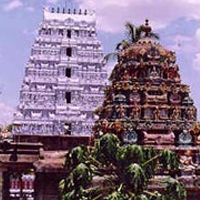
Sri Venugopalaswami Temple in Karvetinagaram lies 48 Kms away from Tirupati. A legendary temple, which dates back to the 14th century is believed to be sanctified by Sri Ramanujacharya. This magnificent shrine holds Sri Venugopalaswami as its chief deity. He is flanked with his consorts, Sri Rukmini Ammavaru and Sri Satyabhama Ammavaru. The temple premises also hold a sub temple in the name of Sri Sita Ramula Pattabhishekam.
A sacred shrine that proffers divinity and hallowness, Venugoplaswamy temple exemplifies exquisite carvings. Awe inspiring look of the temple is mainly due to its amazing Gopuram that displays dazzling craftsmanship of yesterday’s artists. Holy darshan is scheduled between 6.00 to 11.00 hrs and 16.00 to 20.00 hrs every day. Brahmotsavam, Vaikuntha Ekadasi, Teppotsavam and Gokulashtami are the most important festival that is being celebrated every year.
Srikalahasti temple
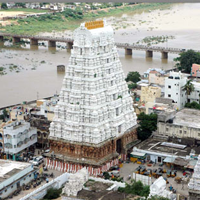
Srikalahasti which is situated on the banks of Swarnamukhi River, is a famous Saivite Temple in South India.Srikalahasti temple is a holy place near Tirupati in the Indian state of Andhra Pradesh. It is located on the banks of the river Swarnamukhi, a tributary of the River Pennar. Site where Kannappa, one of the 63 Saivite Nayanars, was ready to offer both his eyes to cover blood flowing from the Siva linga before the Lord Siva stopped him and granted mukti.
Thousands of pilgrims visits the temple to have darshan of the almighty Sri Kalahasteeswara and Sri Gnanaprasunambika Devi. Sri Kalahasteeswara showers grace to wipe out the sins and obstacles of devotees. The three lofty Gopurams of the temple are remarkable for their architecture. This temple was originally built during Pallava period and current structures are built by Chola Tamil King Kulothunga Cholan I,II and III during 11th century. A huge hundred pillared Mantapam is built by Krishnadevarayar during 16th century which is another important feature of this shrine. It is also the origin of the popular textile painting art called kalamkari. The’Rajagopuram’ or main gate of the 500-year-old Srikalahasti Temple in Andhra Pradesh’s Chittoor District collapsed on 26 May 2010. Srikalahasti is popularly known as “Dakshina Kaashi”.
Sri Kalahasti is named after the staunch devotees of Lord Shiva. They were the Spider (Sri), the Serpent (Kala) and the Elephant (Hasti). Appeased with their unflinching devotion, Lord Shiva gave them a boon that their names be merged with the Vayulinga and called as Sri Kalahasteeswara. A statue that shows all three animals is situated in the main shrine.
Parvati gained Shiva-Gnanam and came to be known as Gnana Prasunamba. Sri Adi Sankara visited this Kshetra and praised the bhakti of Kannappa in his Sivanandalahari.
It is one of the panchabhoota sthalam – representing five basic elements. This temple is the Vayu Sthalam among the Pancha Bootha Sthalams representing Air. The others are – Tiruvannamalai (Thejo sthalam – Fire) Kanchipuram (Prithvi sthalam – Earth) Tiruvanaikaval (Appu sthalam – Water) Chidambaram (Akasa sthalam – Space).
Mahasivaratri is an important festival when lakhs of people offer prayers to seek the blessings of the Lord to attain Mukti. Lord Shiva appeared to Bhakta Markandeya, in Sri Kalahasti and preached that a Guru alone could make esoteric teachings and, therefore he is Brahma, Vishnu and Maheswara.
Srikalahasteeswara Swamy Temple is reputed as the Rahu – kethu Kshetra, If the People who have Rahu Kethu Doshas and sarpa Doshas. The unmarried and No Children and those who are facing various problems for a long period perform the most effective “Rahu – Kethu Sarpa Dosha Nivarana Puja” in this Temple. All the Doshas get removed and desired results occur.
Srinivasa Mangapuram Temple
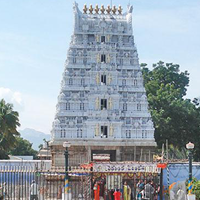
Sri Kalyana Venkateswaraswami temple is believed to be the place where Lord Venkateswara stayed for a while after his holy matrimony with Padmavathi Devi, it is situated at 12 km to the west of Tirupati. This temple at Srinivasa Mangapuram, carries Kalyana Venkateswaraswami as its chief deity. Main shrine in the center includes Garbhagriha, Mahamantapa and Mukhamantap, which are highly ornate and embellished with fine carvings. All together the temple architecture displays the mix of dvitala and vesara order.
The temple premises encompass four sub temples, which include Sri Andal Ammavari temple, Sri Sita Lakshmana Sameta Ramulavari temple, Sri Padmavathi Ammavari temple and Sri Ranganayakula Swami temple. Apart from these four there are smaller shrines like Sri Agastheeswara Swami temple, Sri Sakti Vinayaka Swami temple, Sri Parasareswara Swami temple, Sri Veerabhadra Swami temple and Sri Avanakshamma temple.
Sri Agasteeswara swami Temple
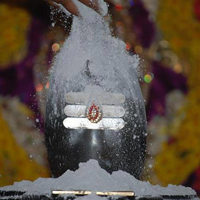
The temple of Agastheeswara Swami is a sacred shrine that lies at the confluence of three rivers Swarnamukhi, Bhima and Kalyani. The Siva lingam in this temple was installed by Agasthya Mahamuni and so it is called Agastheeswara lingam. This temple faces east and has almost all parivaradevathas installed in well-built places like Lord Ganesha, Lord Subramaniyam (elder brother of Lord Ganesha) etc.
The temple has three entrances and a grand compound wall. The Dwarapalakas at the entrance of the sanctum sanctorum are beautifully sculptured. They stand tall to add grandeur to the hall. Inside the second prakara, there is a separate shrine for Mother Parvati called here by the name of Vallimata. There is a tank outside the compound for the convenience of visiting pilgrims. The nearby village was named Tondavada by the kings of Chandragiri, as it was the place used as a rest house for visitors and keeping elephants also.
Just opposite the Aalaya (temple) and in the middle of the river there is a mandapam built. In this, you can see the beautiful statues of Balaji, Ayyappa, Ganapati, etc., installed. There is also a small shrine of Lord Sri Rama, Sita, Lakshmana and Anjaneya that is built in recent times near the tank. All these places are worth visiting.
Talakona waterfall
Talakona waterfall is in Chittoor District of Andhra pradesh, With a 270 feet (82 m)-fall, Talakona is the highest waterfall in the Andhra pradesh state. It is also known for the Lord Siddheswara Swamy Temple, which is located close to the waterfall. Talakona is a resort with waterfalls, dense forests and wildlife. The area was declared a biosphere reserve in 1989 due to the presence of rich variety of flora and fauna.
Talakona means head hill in Telugu (tala – head and kona – hill). However, Talakona allegorically means “the head of the Seshachalam hills” as these mountains are believed to be the starting point of the Tirumala mountain ranges.
The Talakona forests host rare and endangered species of animals like Slender Loris, Indian Giant Squirrel, Mouse Deer, Golden Gecko, Panther, Porcupine, Chital and Sambar. Endemic species like Red Sander, Cycas beddomeii and Enteda like giant plants are also found in this region. The forest is mostly covered with andalwood trees with some medicinal plants.
The waters of Talakona are enriched with herbs and people believe that it has healing properties. A long and treacherous trekking route leads to the top of the hill, which can be reached by multiple paths. Talakona hills geographically is considered a part of the Eastern Ghats.
There is a beautiful waterfall falling deep into the valley from a cliff on the upper reaches. According to the local residents, it is said that the origin of water is difficult to be traced out since an underground stream surfaces here. There is a 240 meter long canopy rope walk, about 35 to 40 feet in height, giving a thrilling experience to the visitors while walking. There are mighty trees around with birds and monkeys during the canopy walk. There are number of trek routes in different categories of difficulty, giving an option for the visitor to choose their route. In the area there is an ancient Siva temple which is flooded with devotees during Sivarathri Festival. There are also deep caves scattered over the mountains where it is believed that sages meditate eternally. A stream flows near the canopy walk area where a bathing ghat is under construction.
Chandragiri Fort
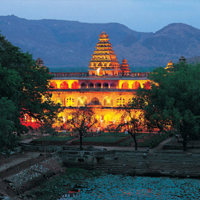
Chandragiri is famous for the Historical fort, built in the 11th century, and the Raja Mahal (Palace) within it. Chandragiri was under the rule of Yadava Naidus for about three centuries and came into control of Vijayanagar rulers in 1367. It came into prominence during Saluva Narasimha Rayalu,he got the title of Mahamandaleswara and his illustrious Prime minister Chitti Gangarayalu (Ganganamatyudu) was known for his vision, wisdom and rectitude and was revered as a Bhisma Pitamaha in his times, he was the person who identified intellectualism of Timmarasu and taken him into the service of Chandragiri and later promoted to the Prime minister of Vijayanagar Empire. Gangaraya discendents served the Vijayanagara empire as trusted Generals and Governors for several generations, Chandragiri was the 4th capital of Vijayanagar Empire, Rayas shifted their capital to here when Golconda sultans attacked Penukonda. In 1646 the fort was annexed to the Golkonda territory and subsequently came under Mysore rule. It went into oblivion from 1792 onward. The fort encircles eight ruined temples of saivite and vaishnavite pantheons. Raja Mahal, Rani Mahal and other ruined structures. The greatest of Hindu Emperors, Sri Krishnadeva Raya of Vijayanagara Empire was brought up at Chandragiri Fort, before his coronation at Penukonda in Anantapur District.
The Raja Mahal Palace is now an Archeological museum. The palace is three storeyed, is an example of Indo-Sarcen architecture of Vijayanagar period. The crowning towers represents the Hindu architectural elements. The palace was constructed using stone, brick, lime mortar and devoid of timber.
Raja Mahal Palace : One of the finest examples of Indo-Saracenic architecture of Vijayanagar period, this imposing three storeyed palace adorned by the crowning towers representing certain Hindu architectural elements, was constructed with stone, brick, lime mortar and is devoid of timber. The central tower that covers durbar hall rises through two storeys. It is said to be the same venue where Sri Rangaraya granted the site of Fort St. George to the British in 1640. The floors are supported by massive pillars while the walls bear fine plaster and stucco decorations.
Rani Mahal Palace : Similar to the Raja Mahal palace in style and method of execution, this edifice with ground floor looking like a stable and first floor containing quarters adorned with ornamental sikhara has a flat roof. Contrary to the popular belief that this place was meant for the queen or harem, the epigraphical record available from the basement speaks this building being a commander’s quarters.
Sound & Light Show Information
1st Show (Telugu) : Nov to Feb: 6.30 pm to 7.15 pm; Mar to Oct: 7.00 pm to 7.45 pm
2nd Show (English): Nov to Feb: 7.30 pm to 8.15pm; Mar to Oct: 8.00pm to 8.45 pm
Ticket Cost : Adult: Rs.20/- Child: Rs.10
Sri Govindarajaswami Temple
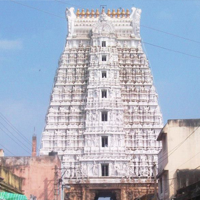
Sri Govindarajaswami is the elder brother of Lord Balaji. The Lord is found with his consorts Rukmini and Satyabhama. The festivals and functions are similar to those conducted in the temple of Sri Venkateshwara temple, Tirumala. Saint Ramanujacharya consecrated the temple in 1130 AD. The architecture of the temple is one of its kinds and is marvellously constructed. The entrance of the temple has a magnificent Gopuram built in 1628 that can be seen even from a distance. To the left of the main Gopuram, is a temple dedicated to Goddess Laxmi who is seated on a lotus. There is also a shrine dedicated to Vedanta Desika, who was a great poet, devotee and philosopher and second great writer of Sri Vaishnava. The annual Brahmotsavam in this temple is celebrated in the month of Vaisakha every year. Pilgrims must visit this temple without fail. This temple complex includes museum and a cluster of shrines like those of Sri Parthasarathy, Godadevi Aandal and Pundarikavalli. The principal deity is an impressive Sayanamurti (the Lord in a sleeping posture).
The timings for Sarva Darshanam are 9.30 a.m. to 12.30 p.m., 1.00 p.m. to 6.00 p.m. and 7.00 p.m. to 8.45 p.m.
Sri Kodandaramaswami Temple
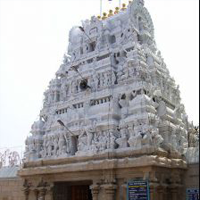
Sri Kodandaramaswami Temple was built by a Chola king during the 10 century AD, it is situated in the heart of Tirupati town. The presiding deities are Rama, Sita & Lakshmana. The temple of Anjaneyaswami, which is directly opposite, is a subshrine of this temple. According to legend, the almighty Lord Rama along with his Goddess Sita and Lakshman made their stay sometime in this temple while their comeback from Ceylon.
It is supposed that Narasimharaya Mudiliyar began the temple construction. The Garbha griha and Antarala shows Vijayanagara influence while the Cornice above the wall is decorated with Simhalalata gables. The Vimana with kuta, panjara, sala, panjara and kutaencompass are ekatala type structures. Above this tala, there is a phalaka containing lions in the four corners. Vertical ribbon in the shikhara belongs to the vesara order. The shikhara is round in shape and it holds a metal kalasa above it.
The Festivals of Ugadi and Sri Ramanavami are celebrated in this temple on a grand scale. Brahmotsavam is celebrated at this temple every year.
Sri Kapileshwaraswami Temple
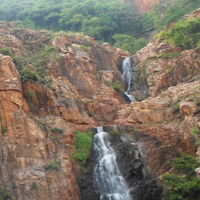
Sri Kapileshwaraswami Temple is the only temple dedicated to Lord Siva, in the pantheon of Vaishnava temples in Tirupati. It is situated about 3 km to the north of Tirupati, at the foot of the Tirumala Hills. The sacred waterfall called Kapila Teertham (also known as Alwar Teertham) is located here. Annual Brahmotsavams and festivals like vinayaka Chavithi, Maha Shivaratri, Skhanda Shasti and Annabhishekam are performed in a grand manner. This is the only Siva Temple in Tirupati. The temple enshrines Sri Kapileshwaraswami. Waterfalls in this place are an attractive sight (especially in rainy season). One can enjoy the peaceful atmosphere, as this place is located a little away from the town. City buses and autos are a means of conveyance to reach the Kapila Teertham.
Kanipakam Vinayaka
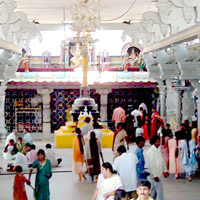
Kanipakam is index to a popular Hindu temple of Lord Ganesha called as Kanipakam Vinayaka Temple. “Kani” means wetland and “Pakam” means flow of water into wetland. It was constructed in the early 11th century by the Chola king Kulothunga Chola I and was expanded further in 1336 by the Emperors of Vijayanagara dynasty. Local legends claim that the idol of Ganesha continuously grows in size. The temple was too small to be patronized by Chola and Vijayanagara kings. The temples of Cholas and Vijayanagaras are normally magnificent in size and grandeur. Most of the present structures are of recent origin and the present major developmental and construction activities of the temple are well supported by offerings given to the temple by the devotees. Ganesha is popular.
This temple became widely known only in the past 10–15 years. Prior to this it was popular only in and around the Chittoor district, but the AP government has been promoting tourism. In addition, the number of buses which run between Tirupati and the local temples allows pilgrims greater transportation flexibility.
According to the Temple legend there were three brothers, each with a handicap : one was mute, one was deaf and one was blind. They earned their livelihood by cultivating a small piece of land. They used channels to irrigate their fields, and as one of them guided the water, the other two drew water. On one such occasion they found that the water in the well dried up and they could no longer continue their work. One of them got into the well and excavated it. He was taken aback when his shovel struck a stonelike formation. He was shocked to see blood oozing out from it. Within a few seconds the clear well water turned blood red. This divine sight cured the three brothers on the spot. As soon as the villagers discovered this miracle, they thronged to the well and tried to deepen the well further but were thwarted when the swayambhu idol (the self-manifested) of Lord Vinayaka emerged from the swirling waters.
Ultimately they offered many coconuts with prayers before the new idol. The coconuts’ water covered than one and a quarter acres. This incident led to the modification of the usage of the Tamil word Kaniparakam into Kanipakam. Even today the idol is in the original well and the springs of the well are perennial. During the rainy season, the holy water overflows from the well even today.
Another striking and strange feature of the idol is that it is growing in size. At present, we can see the knees and the abdomen of the idol. The old and present Kavachams are on public display in the temple and the temple is planning an expansion. The holy water from the well is offered to the devotees as Theertham.
Aragonda – Sanjeevateerdha
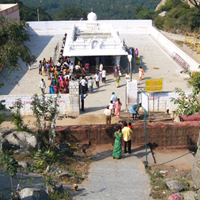
Sanjeevateerdha is situated on a hill called Arthagiri, this hill is situated in the village called Aragonda, which is located at a distance of 12 km from Kanipakam. A part of the hill slipped and fell down while Hanumantha was taking the mountain of Sanjeeva to revive Lakshmana to life in Tretayuga. This place which was called Arakonda gradually became popular as Aragonda. Bhaktha Anjaneyaswamy is situated on the hill, it is said that there are many medicinal values in the lake called Sanjeevateerdha.
Golden Temple
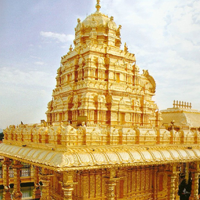
Sripuram – The Golden Temple was built in a short span of 7 years. It was inaugurated on August 24, 2007. The consecration ceremony was witnessed by thousands of devotees. Since then, the temple has attracted hundreds of thousands of devotees; often breaching the 1 lakh mark on special occasions. The temple has also changed the face of Thiruamalaikodi village and the nearby town Vellore. In the coming years, the temple envisages to create a positive influence on the society and ultimately bring about a change.
The Golden Temple is situated in a 100 acre lush green landscape in the middle of a star-shaped path, such that it absorbs maximum energy from nature, which creates enormous peace and brings relaxation to the devotees who walk through the starpath. Devotees walking through the starpath are blessed to read messages of truth and righteousness that enables them to realize themselves and transform into powerful beings. The ultimate purpose of the Golden Temple is to create righteousness and transformation in human beings. The star-shaped path with twelve ‘auspicious’ vertices creates a divine energy form on the Earth, akin to the sacred Srichakra. Messages of truth and righteousness are posted on both sides of the pathway to encourage people to read them and imbibe their meaning as they walk slowly towards the Temple. These messages will cover topics such as the purpose of human birth and human life, the things we should and we should not do, the need for devotion and many more. Walking through the starpath, laid with these messages, creates a rejuvenating experience and reminds oneself of the true purpose of life and nature of the world.
The landscape of Sripuram is completely natural, created and managed using organic manure. One feels closest to one’s true self in this serene ambience. Water from all the major rivers of the country were brought to create the Ecopond – ”Sarvatheertham”. The creation of this pond has resulted in a wonderful ecosystem for birds and insects, complemented by over 20,000 saplings of various species. The entire temple was designed byAmma, as conceived through the divine vision. All parts of the main temple are covered completely in Gold. The temple has nine to fifteen manually prepared layers of gold foil. The temple is adorned with man-made sculptures, ornately decorated pillars and roof. Various facilities have been arranged for the convenience of the devotees who come to the Peedam to receive the blessings of Amma or participate in the activities.
Devotees are requested to dress appropriately and avoid Short pants, Nighties, Lungies, Midi and Bermudas. Tobacco, Chewing gums, Cameras, Mobiles Phones & other Electronic items, Liquor and Inflammable items will be restricted on entry. You are requested to kindly adhere to the rules.
Temple Timings
Abishekam – 4.00am to 8.00 am
General Dharshan – 8.00am to 8.00 pm
Aarthi Seva – 6.00pm to 7.00 pm




 Total Visit : 79624
 Total Hits : 231562